

ENGINE CALIBRATION
From control parameters
to the driving experience.
Calibration translates target engine and vehicle performance into control parameters. Effective technical discussions bring together objectives, operating conditions, data and evaluation methods.
Explore the Principles
Parameters gain meaning from conditions and results.
The same control parameter can have different effects at different speeds, loads, temperatures or vehicle states. Calibration requires repeatable test conditions, comparison of data and actual performance before and after adjustments, and records of hardware and software versions.
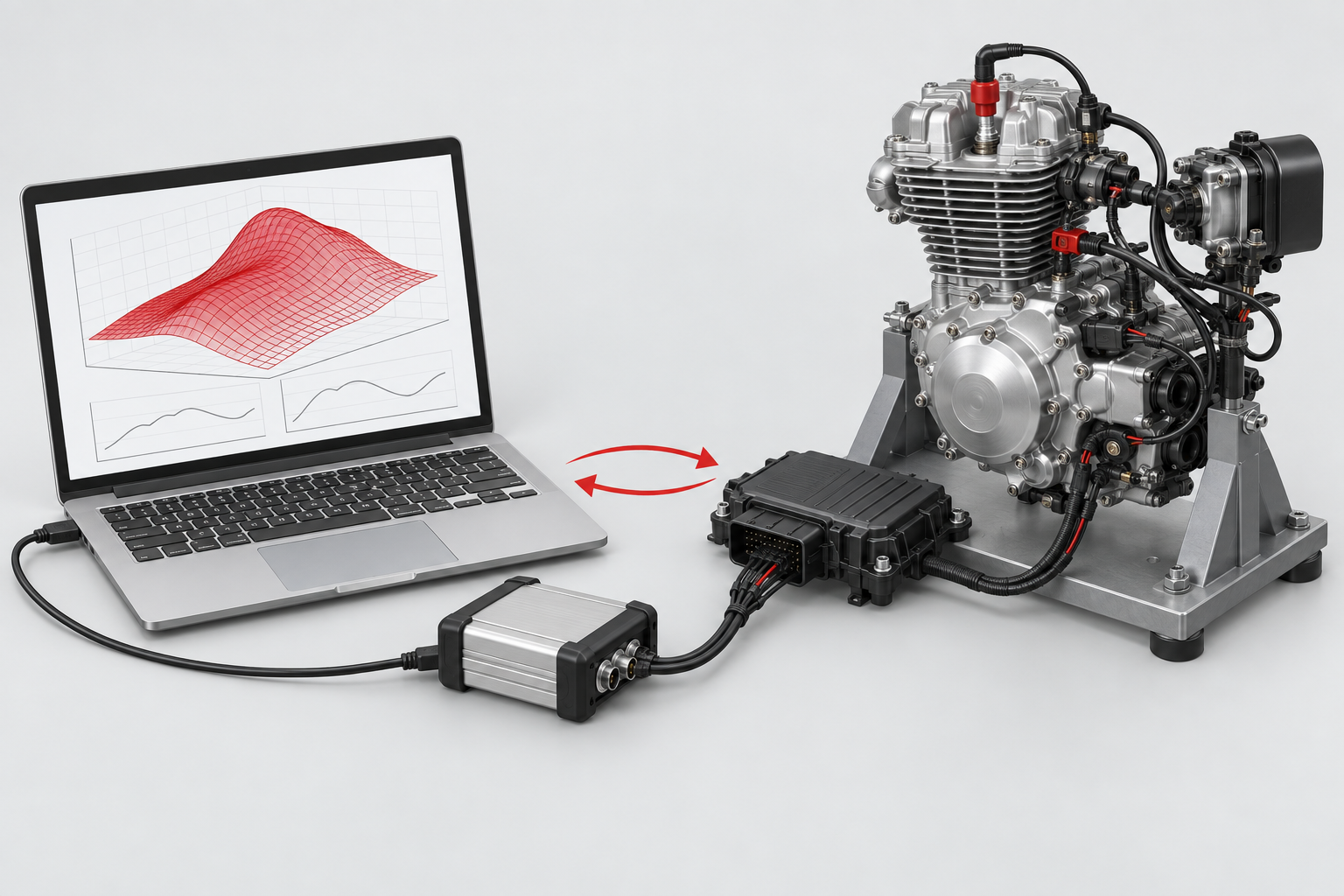
Define Goals
Operating Conditions · Evaluation Criteria
Adjust Parameters
Fuel Injection · Ignition · Operating Corrections
Compare Results
Measured Data · Vehicle Performance
This process illustrates control relationships. Specific inputs, strategies and functions depend on the product configuration.
Engineering Considerations
Starting & Idling
Consider starting, warm-up and idle stability at different temperatures. Define the test conditions before comparing results.
Driving Response
Describe acceleration, throttle release and re-acceleration specifically. Break subjective impressions such as "smoothness" down into conditions, driver inputs and observable responses.
Relationships Between Goals
Power, fuel consumption, emissions and thermal load influence one another. Projects need agreed priorities and evaluation limits; no single parameter represents overall performance.
START WITH THE DETAILS
Before we talk,
gather a few key details.
Current State
Hardware configuration, software version, existing data and issues to resolve.
Target Conditions
Temperature, altitude, load, and road or test-bench conditions.
Evaluation Basis
Target metrics, measurement methods and repeatable evaluation procedures.
Contact Us
Start with your engine.
Tell us about your engine platform, application and project goals to give our technical discussion a clear starting point.