
IGNITION CONTROL
The right timing
for combustion to begin.
Ignition control coordinates spark timing and ignition coil operation. Together with fuel delivery, engine design and operating conditions, it influences engine performance.
Explore the Principles
Consider ignition timing in its operating context.
Ignition timing is generally expressed as crank angle. Appropriate ignition advance may change with engine speed, load, temperature and combustion conditions. Ignition energy also depends on coil characteristics, supply voltage and dwell time.
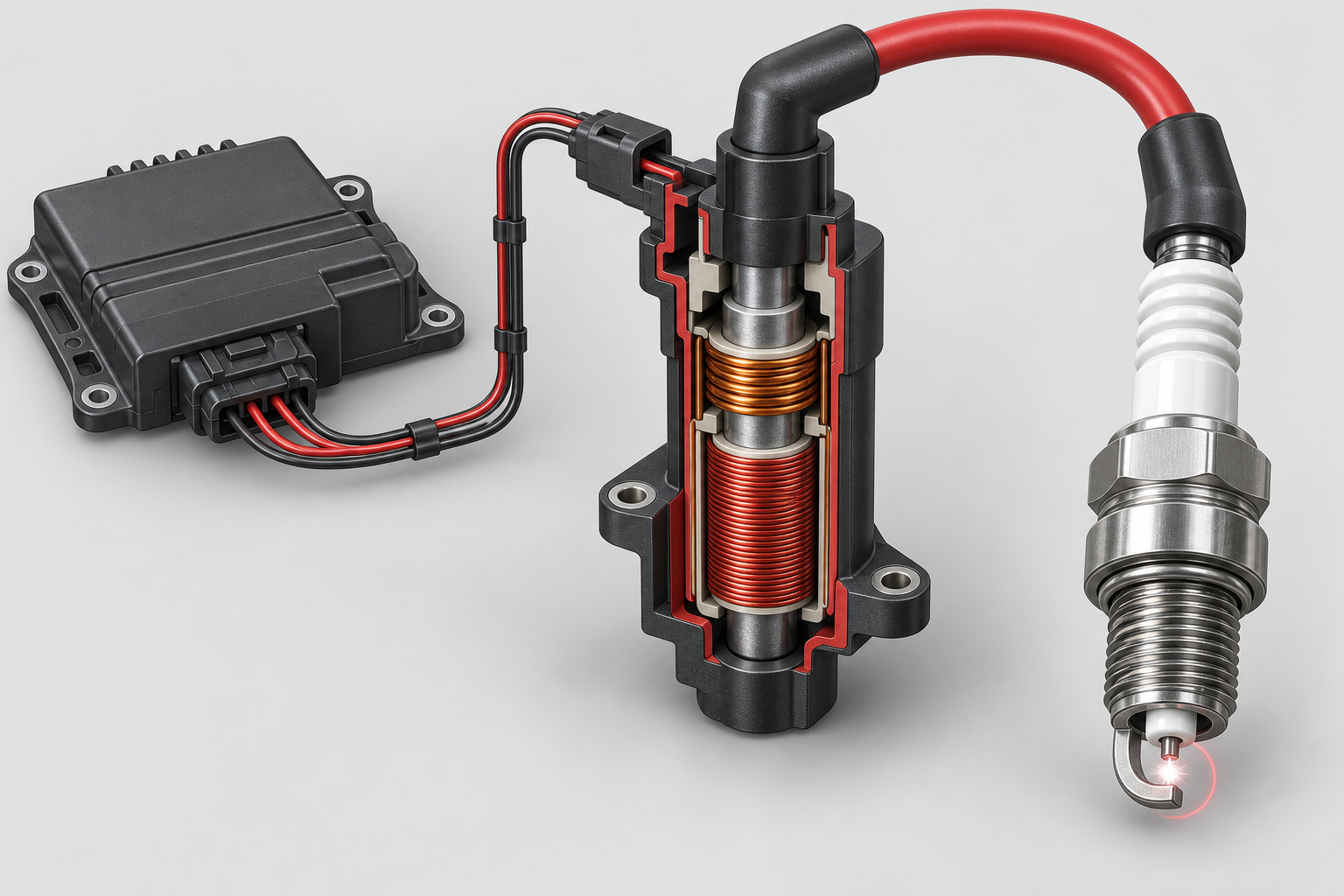
Determine Position
Crankshaft Position · Engine Speed
Determine Timing
Base Ignition Timing · Operating Corrections
Generate a Spark
Coil Charging · Ignition
This process illustrates control relationships. Specific inputs, strategies and functions depend on the product configuration.
Engineering Considerations
Ignition Advance
Ignition advance must suit combustion speed and mechanical limits. More advance or retard is not necessarily better; torque, temperature and combustion stability should be evaluated under specific operating conditions.
Coil & Dwell Time
The ignition coil requires an appropriate dwell time. Coil characteristics and supply voltage are important inputs when discussing ignition drive configuration.
Coordination with Fuel Injection
Fuel injection and ignition interact during starting, idling and load changes. An isolated parameter often cannot explain the overall engine response.
START WITH THE DETAILS
Before we talk,
gather a few key details.
Engine Design
Combustion chamber, compression ratio, crankshaft signal and firing order.
Ignition Hardware
Ignition coil, drive method, supply voltage and spark plug configuration.
Evaluation Goals
Priorities for starting, idling, acceleration and sustained operation.
Contact Us
Start with your engine.
Tell us about your engine platform, application and project goals to give our technical discussion a clear starting point.